The GPL plugin marketplace has exploded in the last few years. What started as a niche corner of the WordPress ecosystem — where savvy developers could access premium plugins and themes at a fraction of retail cost — has grown into a crowded, competitive industry with dozens of providers all promising the same thing: “100% original files, regular updates, unlimited downloads.”
So if everyone is making identical promises, how do you separate the real from the rhetoric?
The answer, as any developer who has worked with multiple GPL providers quickly discovers, comes down to two things: how reliably they deliver updates and whether their support actually responds. Everything else is marketing copy.
This post is about why GPL Daddy does both better — and what that practically means for developers and agencies building WordPress sites at scale.
First, Let’s Be Honest About What the GPL Marketplace Really Is
The General Public License is not a loophole — it’s a legal framework. WordPress itself is GPL-licensed, and by extension, all themes and plugins that run on WordPress must also be GPL-licensed. This means the code is legally distributable by anyone. GPL marketplaces like GPL Daddy purchase legitimate licenses for premium plugins and themes, then redistribute them to members at significantly lower prices.
This is entirely legal. It’s been tested and affirmed. The nuance that most people miss is that while the code is GPL and freely distributable, premium support and automatic updates from the original developer are not. Those are services tied to an active subscription, not the software itself.
This is where GPL marketplaces live or die. Because their job is to fill that gap — to provide the code and a meaningful layer of updates and support on their own. And most of them fail at this spectacularly.
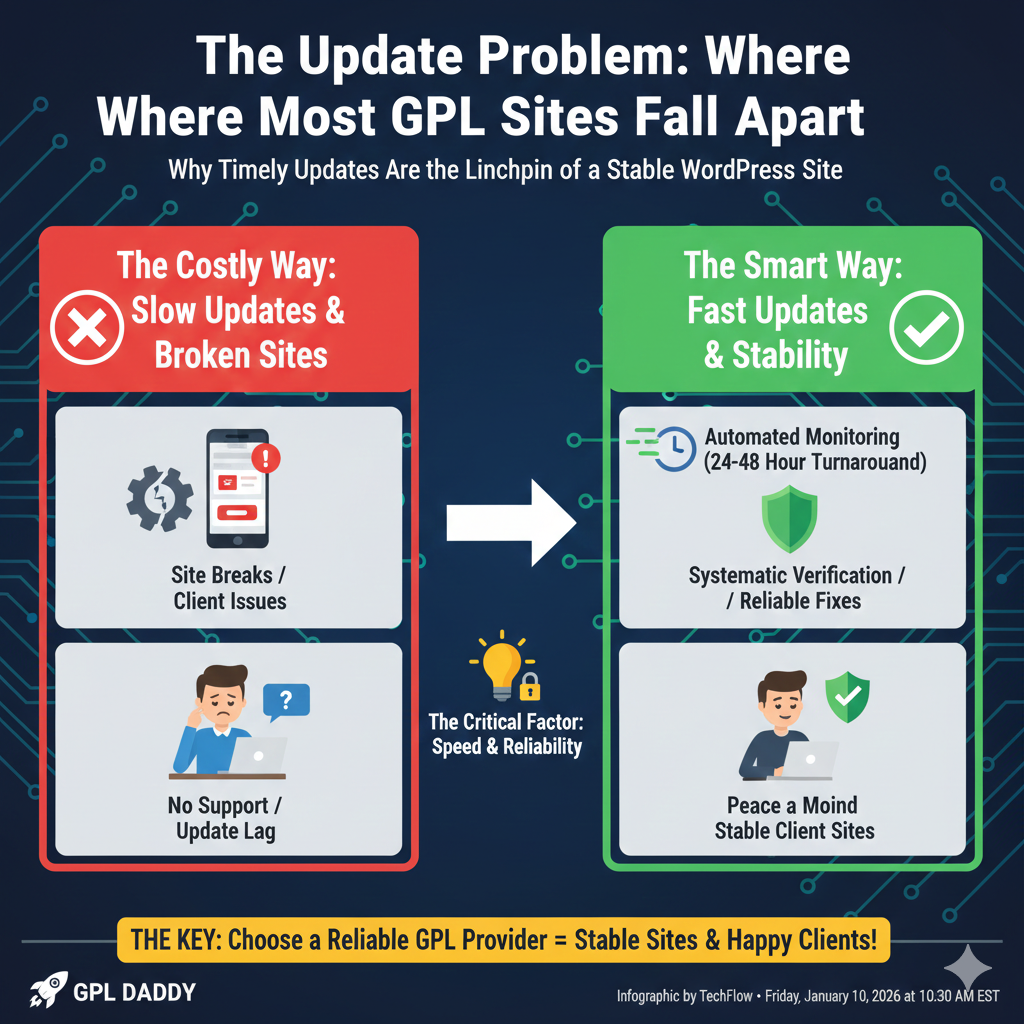
The Update Problem: Where Most GPL Sites Fall Apart
Here’s a scenario that every developer using a cheap GPL service has experienced at least once:
You install WooCommerce, an SEO plugin, or a page builder from your GPL provider. Everything works beautifully. Three months later, WordPress releases a major version update. The plugin developer pushes compatibility patches. Your client’s site starts throwing warnings, or worse, breaks silently in the background.
You go to your GPL provider to download the updated version. It’s not there yet. You check their update log. The last update was eight weeks ago. You post in their support forum — no response. You submit a ticket — automated reply, then silence.
Meanwhile, you’re on the phone with your client explaining why their checkout page stopped working.
This is not a hypothetical. It’s the daily reality for developers who chose their GPL provider based on price alone.
The update lag problem exists because maintaining a comprehensive plugin library with genuinely timely updates is hard work. It requires dedicated systems, monitoring tools that flag when developers push new versions, and actual human beings whose job it is to process and publish those files quickly. Most budget GPL sites are running on thin margins with minimal staffing. The economics simply don’t support fast turnaround.
GPL Daddy operates on a different model. Updates are processed through an automated monitoring pipeline that tracks upstream developer releases across our entire plugin and theme catalog. When an update is pushed by the original developer, our system flags it, the file is verified and processed, and it’s available in your dashboard — typically within 24-48 hours, often faster. This isn’t a manual process dependent on someone remembering to check. It’s systematic.
Automatic Updates: What It Actually Means (and What It Doesn’t)
Let’s clarify something that causes real confusion in the GPL space, because different providers use the phrase “automatic updates” to mean wildly different things.
Some providers call it “automatic updates” if they eventually update their library — even if it takes weeks. Others mean that if you actively check for updates in your WordPress dashboard, the plugin will flag that an update exists somewhere on their site. That’s not automatic. That’s manual with extra steps.
At GPL Daddy, automatic updates means your installed plugins can receive update notifications directly through your WordPress dashboard, exactly the way you’d see them from a legitimate licensed plugin. Through our update system integration, your WordPress installation checks against our servers, sees the latest available version, and notifies you — or updates in the background if you have that configured. You don’t need to log in to our site, download files, and manually replace them via FTP. That’s not a workflow anyone should still be doing in 2026.
This matters enormously at scale. If you’re managing five sites, manual updates are annoying. If you’re managing fifty, they’re a full-time job. If you’re running a hundred client sites — which many of our agency members do — manual plugin management without a reliable update infrastructure is simply untenable.
The Support Reality Check
Support is where GPL providers show their true character most clearly, because it costs money to do well and generates no direct revenue. It’s tempting for providers to treat it as an afterthought — a ticket system that gets checked when someone remembers to check it.
The frustration developers have with most GPL services isn’t even about resolution time. It’s about acknowledgment time. When your site is broken and you open a ticket, waiting 72 hours to find out if anyone has even read your message is its own particular kind of pain.
GPL Daddy’s support structure is built around the reality that plugin issues don’t follow business hours. Our support team operates across multiple time zones with defined response windows. Ticket acknowledgment happens within hours, not days. For critical compatibility or installation issues, our technical team responds with actual solutions — not copy-pasted documentation links.
We also invest heavily in the support infrastructure that reduces the need for tickets in the first place: detailed installation guides for every major plugin category, compatibility matrices showing which plugin versions work with which WordPress versions, and a community forum where developers can share workarounds and tips before an official fix is even published. Good support isn’t just reactive — it’s proactive, building knowledge systems that help members help themselves.
What Developers Actually Care About: A Practical Comparison
Let’s move past the marketing language and talk about what matters in real daily use.
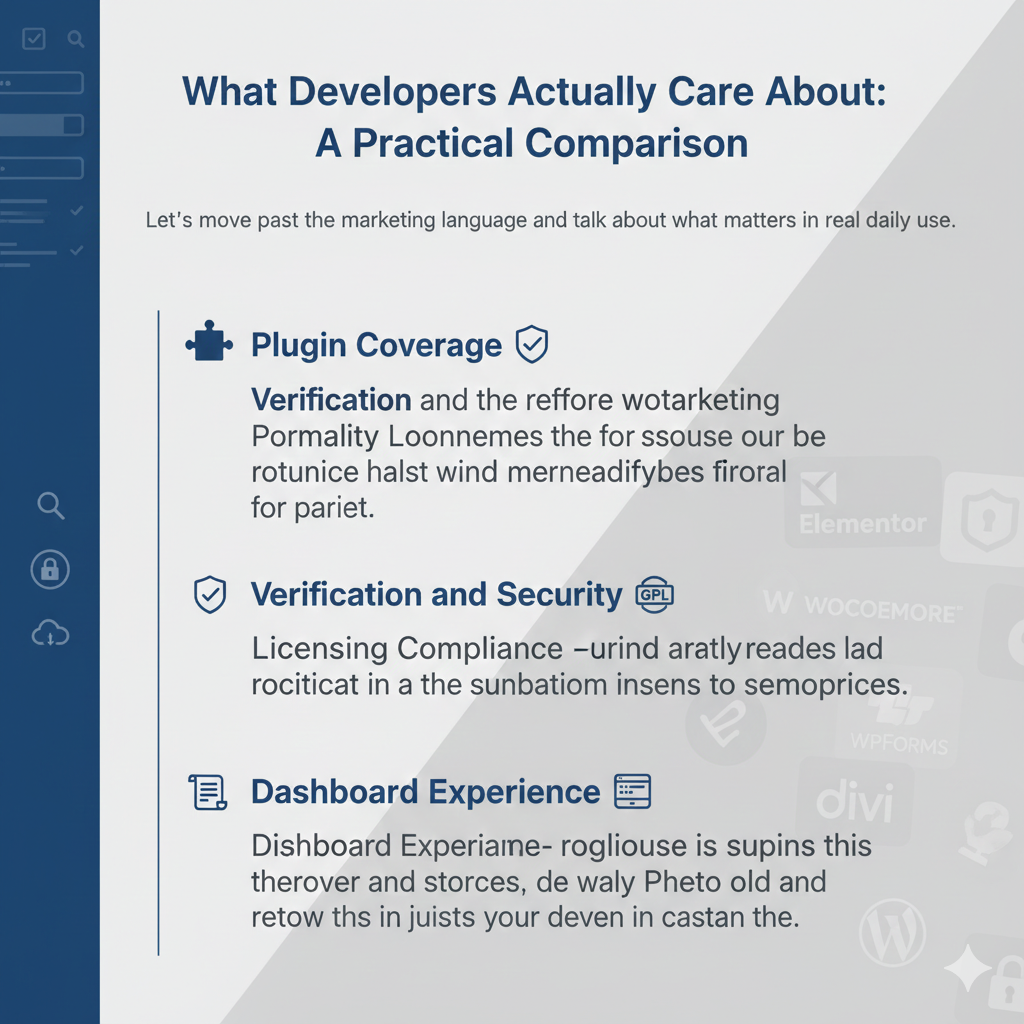
Plugin Coverage: A GPL service is only useful if it carries the plugins you actually need. GPL Daddy’s catalog covers thousands of premium plugins and themes — including the major commercial staples like Elementor Pro, Divi, WPForms, Gravity Forms, ACF Pro, WPML, and WooCommerce extensions. The catalog is continuously expanded based on member requests, which means the library grows toward actual developer needs rather than arbitrary collection decisions.
Verification and Security: One of the legitimate risks in the GPL space is modified files. Some disreputable providers inject malicious code into plugin files before redistributing them — essentially backdooring your clients’ sites while giving you a file that looks legitimate. GPL Daddy runs every plugin through security verification before it enters our distribution system. Members can be confident that what they download is clean, unmodified original code. This is non-negotiable for any provider worth trusting.
Licensing Compliance: We only distribute plugins that are fully GPL-licensed. There are some premium products — particularly certain themes — that use “split licensing,” where the PHP code is GPL but the CSS and JavaScript carry separate commercial licenses. We’re transparent about these distinctions and only distribute components that fall clearly within GPL licensing. No gray areas, no surprises for your clients.
Dashboard Experience: The member dashboard isn’t an afterthought. Search is fast, filtering by category works correctly, and version history is accessible so you can download a previous plugin version if a new release introduces bugs. Small things — but the kind of small things that matter when you’re working fast.
Why the Price-Only Comparison Is the Wrong Framework
When developers first explore the GPL marketplace, the natural instinct is to comparison-shop on price. You’ll find providers at ₹99/month, ₹199/month, and ₹499/month — and at first glance, the cheapest option looks like the obvious win. The plugin files are the same, right? They all say “unlimited downloads.”
This logic breaks down the moment you factor in the cost of a single production incident.
One hour of developer time spent manually tracking down an updated plugin file, downloading it from a different source, and deploying it — that’s real cost. One client call about a broken site during a delayed compatibility fix — real cost. One month of your team manually logging into a dashboard and downloading updates for fifty sites instead of having a working automatic update pipeline — real cost, every single month.
The math almost always favors the provider that does updates and support properly, even if their membership price is higher. The savings aren’t in the membership fee; they’re in the operational hours you don’t spend firefighting.
The GPL Daddy Commitment Going Forward
The GPL space is maturing. The race-to-the-bottom providers are slowly being filtered out as developers wise up to the operational cost of unreliable services. What’s emerging is a clearer differentiation between providers who treat this as a commodity business and those who treat it as a service business.
GPL Daddy is firmly in the second camp. Our roadmap for 2026 includes expanded API integrations for developers managing large site networks, deeper compatibility tracking across major WordPress releases, and expanded plugin catalog coverage in niche categories like LMS plugins, membership systems, and advanced WooCommerce extensions.
When you’re building client sites — especially when a new project is launching and you’re considering everything from the tech stack to the business infrastructure around it — having a reliable GPL source changes how confidently you can commit to timelines. Fast access to the right plugins, with automatic updates baked in from day one and support you can actually reach, removes a category of risk from your workflow entirely.
For developers who want to see how their new projects look from an SEO and discoverability standpoint right after launch, pairing a solid plugin stack with a proper XML sitemap setup ensures search engines find and index the site quickly — especially when clients are eager to see organic results early.
GPL Daddy isn’t the cheapest option in the market. We’re not trying to be. We’re trying to be the one that actually works — consistently, reliably, and with the kind of responsive support that makes you confident recommending it to your clients and colleagues.
That’s the difference. And in this market, the difference is everything.